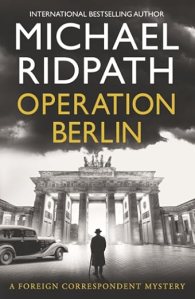
I thoroughly enjoyed Michael Ridpath’s Operation Berlin, a murder-mystery set in Germany between the Wars. It is well-written, a well-constructed murder mystery puzzle that obeys the rules of the genre, and stands alone as an excellent story. In the smoke-filled cabarets and fractured streets of 1930 Berlin, silence is often a survival tactic. But in this gripping new murder mystery, historian Archie Laverick finds that the ghosts of the Great War are not easily laid to rest.
Operation Berlin by Michael Ridpath
Archie Laverick is a refreshing departure from the typical detective he is a scholar scarred by shell shock (PTSD), his battle is internal. His journey to Berlin to research a Prussian general is a credible setup; grounding the story in the glorious military history of Germany’s past. Archie’s physical and mental fragility adds a layer of high-stakes tension to the narrative. He isn’t a man of action in the traditional sense, but a man of observation, making him a formidable, if reluctant, investigator.
Esme Carmichael provides the perfect narrative spark. She is a ‘spirited young American’ seeking her break as an international correspondent. Esme represents the relentless pursuit of truth in a city built on secrets. The dynamic between the weary, cynical historian and the ambitious, modern journalist drives the plot forward, bridging the gap between the academic study of the past and the urgent, dangerous headlines of the present.
Michael Ridpath captures some of the simmering resentment of a nation rebuilding after WW1. By centering the mystery around a shooting at a Saxon castle and a young Communist woman wrongfully accused, the novel leans heavily into the real-world tensions of the era so that the first shadows of a new conflict are the catalyst for the crime itself.
This is more than a ‘whodunit’. It is a sombre, atmospheric exploration of how truth becomes a liability when a society is desperate to reinvent itself. With a collection of credible characters, from embittered veterans to political chameleons, the book successfully navigates the intrigue of the Weimar Republic.
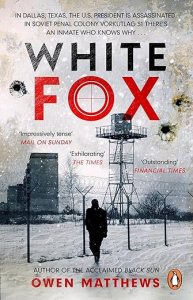
I read White Fox by Matthew Owen, a Cold War thriller, with great pleasure.
White Fox by Matthew Owen
The year is 1963. Alexander Vasin, a disgraced KGB officer, has been exiled to the worst posting imaginable: head of a remote Siberian gulag where the Soviet regime sends its own fallen intelligence officers to disappear quietly. When a prisoner revolt erupts, Vasin finds himself fleeing across the frozen wastelands with a mysterious prisoner who may hold the most dangerous secret of the Cold War era, the truth about who really ordered J.F. Kennedy’s assassination.
What follows is a relentless cat-and-mouse chase from the desolate gulags of Siberia to the grey, oppressive neighbourhoods of St Petersburg, with the full machinery of the KGB hunting them both.
Owen has crafted a page-turner that doesn’t sacrifice character for plot or atmosphere for pace. The tension builds beautifully, with expertly timed rises and falls that kept me constantly focused. Just when I thought Vasin has found a moment of safety, Owen pulled the rug out. Just when the net seemed to be closing inescapably, a desperate gambit opened a sliver of possibility.
This isn’t the relentless, exhausting assault of some modern thrillers that mistake constant action for tension. Owen crafts his story’s suspense from letting readers catch their breath just long enough to wonder what comes next.
The real triumph of White Fox is its characters. Alexander Vasin feels utterly authentic, a man caught between his conditioning as a Soviet officer, his survival instincts, and a gradually awakening moral compass. He’s neither hero nor villain, but something far more interesting: a product of his system trying to navigate impossible choices.
The supporting cast is equally well-drawn. Even minor characters who appear briefly feel like real people with histories, motivations, and inner lives. This is crucial in a thriller set in the Soviet system, where paranoia, loyalty, and betrayal form an impossibly tangled web. You can never quite be sure who will help, who will betray, and who will surprise you entirely. I especially enjoyed the description of the street kid gang in St Petersburg\
Owen resists the temptation to make his Soviet characters into cartoonish villains or his protagonist into a secret Western sympathizer. These are people operating within the logic of their world, which makes their choices feel genuine and their conflicts deeply human.
Owen’s writing captures the bleak and sometimes hopeless atmosphere of Soviet Russia with remarkable precision. The frozen Siberian wasteland feels genuinely hostile; not just cold, but a place designed to break a human spirit. The grey Soviet streets convey that distinctive combination of monumentalism and shabbiness, grandeur and decay.
But it’s the smaller details that really sell the setting: the ritual of drinking in a communal apartment, the careful dance of conversation in a bugged room, the way people measure risk in every interaction. Owen clearly understands the texture of life in the Soviet system, where everyone is simultaneously watcher and watched.
The inclusion of the JFK assassination as a plot element could easily have felt gimmicky, but Owen handles it deftly. Rather than trying to “solve” the assassination or present a definitive alternate history, he uses it to raise the stakes to world-historical levels while keeping the focus squarely on his characters’ personal struggles. (And he explains it in more detail in the Author’s Notes at the end of the book – most interesting!)
The question isn’t really whether there was Soviet involvement in Kennedy’s death; the question is what Vasin will do with dangerous knowledge, what loyalty means when your country has betrayed you, and whether truth matters more than survival.
I should confess something embarrassing: I only realized after finishing White Fox that it’s Book 3 in Owen’s trilogy. I’d previously read and thoroughly enjoyed Black Sun (Book 1), loved it, and have Book 2 (Red Traitor) sitting on my shelf. Somehow, I managed to read the series out of order, but I think it doesn’t matter other than to explain how Vasin had been transferred from Moscow to Siberia.) In fact, White Fox works perfectly as a standalone thriller. Owen provides enough context that I never felt lost, and the story is complete in itself. That said, now I’m even more eager to read Red Traitor to see how Vasin’s journey developed between the two books I’ve experienced. And really, who’s never eaten dessert in the middle a meal? So read a trilogy out of order – it’s called ‘living on the edge’ in reader form 🙂
White Fox is a superb thriller that respects its readers’ intelligence while delivering genuine page-turning suspense. Owen has created a protagonist worth following through multiple books, a setting rendered with atmospheric precision, and a plot that maintains tension without sacrificing plausibility.
The Black Loch by Peter May is a reasonably simple read but it’s a really good murder mystery / suspense set in the Scottish islands. The body of an eighteen-year-old TV personality, Caitlin, is found on a beach and so the story begins. The prime suspect is Fionnlagh Macleod; his father is Fin Macleod, a retired police detective who used to work on the island. He returns to investigate and hopefully to protect his son who was having a secret affair with Caitlin.
The Black Loch by Peter May
What elevates this book above the ordinary crime story is the authenticity. The characters feel suitably real, their dialogue rings true, and the Hebridean landscape becomes almost a character itself, dull and tough, affecting both the characters’ and the plot’s mood. The Scottish Island setting does what it does best: creating a character-driven narrative where isolation, a tightly knit, long-time community drive behaviour.
I really liked that the author knitted childhood memories, school-day relationships, and long-buried mistakes into a plot that feels simple, made sophisticated with quality writing. This is contemporary bestseller fiction at its finest, accessible without being too simplistic, suspenseful without relying on cheap factory-fiction tricks. The story’s exploration of family ties and hidden relationships unfolds with intriguing precision, building toward a tense climax at the salmon farm cages of East Loch Roag. Really, this book deserves to be a movie.
The writing quality is consistently high-quality, demonstrating Peter May’s command of pacing and atmosphere and, I suspect, his experience, this being his 30-something-th book. His ability to evoke place is particularly striking, the Black Loch seems to be a broad metaphor for the many dark secrets lurking beneath the characters’ seemingly calm surfaces.
This is the kind of book I ration toward the end, reluctant for it to end and so to leave its world behind. For readers who appreciate atmospheric crime fiction where setting and character matter as much as plot, The Black Loch delivers a thoroughly satisfying experience.
The Seventh Son, by Sebastian Faulks, begins with an intriguing premise but ultimately doesn’t live up to its potential because of flat characterization and a meandering plot.
The Seventh Son by Sebastian Faulks
The story is spans three decades (from 2030) and follows Talissa Adam, a penniless student who becomes a surrogate for an IVF programme at London’s Parn Institute run by tech billionaire Lukas Parn who is conducting ethically dubious research involving earlier human species. The resulting child, Seth, is raised by his loving parents Alaric and Mary, unaware of his unique biology. The scientific concepts are interesting, touching on evolution and species selection, Faulks fails to bring much depth to the story. The characters are shallow: Parn is a generic tech villain, a ‘man-baby’ whose megalomania feels borrowed from contemporary headlines. But the biggest character error is in the book’s perspective – the story is told from the wrong character (in my opinion) – Talissa and not Seth.
Seth is the genetically engineered child at the story’s heart. He remains distant and opaque and I couldn’t help wondering how much more compelling his story would have been if told from his viewpoint, allowing readers access to his unique take on the experiment that created him.
The pacing suffers in the second half, weighed down by scientific expositions and descriptions of meals that added nothing to the story. At times I questioned whether this was written by Faulks. Where the story could have built tension and philosophical complexity, it drifted into mundane detail.
The Last Lifeboat by Hazel Gaynor is a poignant, emotionally charged novel set against the backdrop of World War II. Hazel Gaynor draws inspiration from real events to tell the intertwined stories of two women: Alice King, escorting a group of children across the Atlantic to safety in Canada, and Lily Nicholls, waiting anxiously in London for news of her own children’s safe arrival. When disaster strikes at sea, their lives become unexpectedly connected.
The Last Lifeboat by Hazel Gaynor
I thoroughly enjoyed the novel, despite a somewhat slow start and an occasionally overly romanticised portrayal of wartime London. Gaynor’s writing is engaging and fluid, capturing both the vast, terrifying isolation of the Atlantic and the quiet, domestic struggles on the home front. This is very much a women’s story — focusing on motherhood, resilience, and the emotional toll of war from a civilian perspective. While this lens brings intimacy and heart to the narrative, it also sometimes lends the story a slightly soft-edged, idealised tone, particularly in the London scenes which seem less gritty than one might expect from the height of the Blitz.
The novel is well-written, though a few Americanisms crept into the British dialogue, which felt a little jarring given the UK wartime setting. The central lifeboat scenes — while tense and moving — could perhaps have been developed even further to fully capture the harrowing ordeal of eight days adrift at sea.
Nonetheless, The Last Lifeboat remains a compelling and heartfelt read, offering a different perspective on the familiar World War II narrative. It shines a light on the lesser-known evacuation of children overseas, and the quiet heroism of ordinary women facing extraordinary circumstances. For readers who enjoy historical fiction with strong emotional threads, this book will not disappoint.




 Books and beans