Category Archives: Uncategorized

Books: The Curious Case of Seaman Garber

The Curious Case of Seaman Garber by B. K. Mayo is the story of 11-year-old Seth Roberson and the adventure he and his best friend Collin have during their summer school vacation.

The Curious Case of Seaman Garber by B.K. Mayo

The two boys are playing in an unused, closed-off forested area with a large shallow pond. As boys in summer vacations do, they built a raft, paddled out onto the pond and discovered a drowned corpse. The police and the boys’ parents are called and eventually it is revealed that the corpse is that of an elderly recluse, an ex-Vietnam War veteran, Henry Garber who lived alone in a cabin overlooking the pond. Seth is troubled that the police are unable to locate any of Garber’s family or friends and so he asks his father to accompany him to Garber’s funeral. Shortly afterwards, to everyone’s surprise, Seth is named the sole heir to Garber’s estate. Seth is insistent that he didn’t know Garber and they’d had just one, ironic conversation – Garber had warned him to be careful not to drown in the pond. Seth’s father recognises an old photo while they are clearing out the cabin. The photo shows Garber just before he left for Viet Nam, standing next to Seth’s grandmother. She reveals that Garber was her husband and so Seth’s grandfather. PTSD broke their marriage but some years later Garber moved back closer so he could watch his son, Seth’s father, growing up. The story concludes with an intriguing and heroic twist when a man from the Viet Nam Embassy visits Seth’s family home to reveal more of Garber’s time in Viet Nam.

This is a well-constructed plot that is paced well. The main characters are likeable and well-created and have interesting back stories. It is a compelling and thought-provoking story with a high degree of credibility/authenticity.

Books: Young Beasts at Play

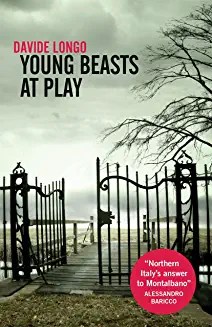
Set in Northern Italy, Young Beasts at Play by Davide Longo, is a gradual untangling of a convoluted mystery of dead bodies and living but silent witnesses from Italy’s Fascist past.

Young Beasts at Play by David Longo

Commissario Arcadipane is assigned a case of 12 bodies discovered in the countryside near Torino. The next day a taskforce that specialises in working with mass graves from World War 2 moves into the case, but there is compelling evidence showing that at least one of the corpses was killed more recently. Arcadipane calls in a retired colleague and a young, troubled but brilliant officer and together they gradually unravel the mystery. Combining forensic science and sound local knowledge, the group discovers the identity of one of corpses and follows the trail to Spain where the whole case is resolved. This story really does have a well created ending.

This was an excellent read, thoroughly absorbing and enjoyable. The North Italian setting gave an exotic feel without the book turning itself into a poetic jaunt through Tuscan lavender fields. A rich and textured setting can help a book, but it can also overwhelm a plot and the characters; in this book the setting it was kept subdued. The characters were developed with such reality, flawed but principled and motivated, especially Arcadipane with his troubled home life and the historical relationship of his retired colleague with the facts and victims of the case. The plot began by resembling a giant mass of tangled string and by the end, it was untangled and everything was rolled away neatly. Bravo.

Beans: The French Press

The French Press, called a plunger in the southern hemisphere and a cafetière in France, is a simple mechanism that gives me maximum control over the variables that make up my cup of coffee: water volume and temperature and weight of coffee. Quite simply, coarsely-ground beans are added into the French Press followed by hot water. The lid mechanism is fitted, the coffee grounds are left to steep for around 3-5 minutes and then I press the grounds to the bottom of the vessel allowing the mixture to be poured into my cup.

Photo by Georgi Petrov on Pexels.com

The French press method lets the coffee steep instead of being filtered, so more of the coffee’s oils are released into the water. As I wrote a few weeks ago, it’s these oils that make the coffee taste richer and better. The Press method adds no impurities, which usually happens with filters.  Using a French Press means there is only hot water and freshly-ground coffee being poured into your cup. All of the ground coffee is saturated so a maximum amount of oil, and therefore flavour, is released. Drip and filter mechanisms can’t create maximum saturation so drip and filter coffee can’t be as rich as coffee made with a French Press.

Most significantly, a French Press allows me to control the temperature and volume of water as well as the quantity of coffee going into the mixture. It’s OK to be a science geek and experiment with different water temperatures and volumes and different quantities (weights) of coffee grounds. I do and I make notes like a coffee scientist and I’m careful to use exact volumes and weights and temperatures. I weigh the coffee because different varieties have different densities and weight is more accurate than say the number of beans or spoonfuls. African coffees tend to be denser than South American coffee and this density difference means measuring the coffee by volume won’t be as accurate and therefore as consistent as measuring it by weight.

The remaining variable is the time to leave the ground coffee to steep in the hot water. After one minute of saturating or steeping, the grounds have usually floated to the surface so I stir the mixture briefly to maximise the exposure to the hot water. The goal is to release the maximum amount of oil from the grounds. After 2-3 more minutes of steeping, I press the mixture and then pour the coffee. 

If I use the same volume of water and vary the weight of coffee, the water temperature, and the time taken to saturate the grounds, I can definitely taste a difference Adjusting the variables till I achieve the perfect flavour is the science of the French Press. And when I get it right, the coffee is wonderful and rich and satisfying and… perfect. 

Books: China Hand

China Hand by Scott Spacek is a highly-recommended suspense/thriller told by Andrew Callahan, a fresh young Harvard graduate on a one year teaching stint in a Chinese university before joining a prestigious global consulting firm.

China Hand by Scott Spacek

Almost immediately Andrew is attracted to and begins a relationship with Lily, the Dean’s assistant, who also happens to be an Army General’s daughter. Shortly afterwards, Andrew is approached to help the CIA extract a Lily and so is effectively recruited into the CIA with all the risks associated with detection and capture that that entails.

While the plot is initially set in and near the university in Beijing, we are given fleeting glimpses of the colourful local culture as Andrew explores occasional nightclub, restaurant and a boxing club. The setting though is primarily the politically- and culturally-charged university in which USA and by extension ‘all Americans’ are vilified. As anti-USA protests due to USA’s bombing the Chinese Embassy in Belgrade build, Lily’s escape becomes a matter of urgency.

I read the latterhalf of this book in one sitting because the pace picked up significantly and the story quickly turned into an action-suspense-thriller as Andrew helped Lily escape from the university. They soon met with Lily’s mother, whose escape had been helped by another US university teacher/CIA agent and friend of Andrew. Their escape plan was discovered almost immediately forcing them off-script. This involved a long van ride, a plane trip, a train trip, a street chase followed by a shoot-out in a shopping mall, separation from Lily and her mother, and ultimately a high-tension boarding of a ferry to Korea. That’s certainly not where the story ended, but because this is a suspense, I’ll stop there.

The 1980s were a grim time in China, especially if you were an American living and working there and the story reflects that. Nonetheless, I felt the author didn’t give me enough of the exotic culture and setting. There were brief references to eating in restaurants and navigating the city and the air pollution but these were too brief, in my opinion.

I thoroughly enjoyed reading a fast-paced novel written in the first-person because it ‘sounded’ like I was being told the story by the one person who could tell it the best, the protagonist. This adds to the story’s authenticity and credibility. The relationship between Andrew and Lily felt genuine and the danger associated with their capture while running from the Chinese authorities felt more urgent for the story being told in the first person. (I wish there were more thrillers written in the first person.)

I wholly recommend China Hand to those who enjoy a fast and thrilling read with a snappy finish.

Books: Follow me to the Edge

Tariq Ashkanani’s Follow Me to the Edge is a detective story about Joe Finch and his journey to solving a family’s murders and the mystery surrounding his partner’s roadside shooting a few months earlier. Finch is the quintessential flawed character, not coping with his marriage break up and struggling even more with his ex-partner’s shooting during a routine traffic stop.

Follow me to the Edge by Tariq Ashkanani

I enjoyed the book’s pace, the parallel stories which we know for sure will come together at some stage, and the layered relationships.

In small-town Cooper, Nebraska, a man is found dead at a lake and shortly afterwards, his whole family is found beaten to death in the family home. The suspicion of course is murder-suicide, but the evidence doesn’t support this. The crime scene is the house in which Finch grew up; where his mother committed suicide after killing her son, Finch’s brother, who was suffering with incurable cancer. Shortly afterwards, Finch and his father left their family home and shortly after that, his father left him with friends before leaving Cooper for good.

Crooked politicians, organised crime, an unprofessional and over-ambitious reporter, corrupt police colleagues, and small town neighbours, many of whom are also Finch’s ex-school mates, combine to make for a muddy and difficult investigation. And to make it worse, the case is quickly assigned to a newly-appointed, ex-Texas detective to partner with Finch.

There is a parallel story of a religious cult on a farm on the outskirts of Cooper which eventually merges into Finch’s investigation and its conclusion.

This detective novel is suspenseful, filled with activity and well-paced. Evocative and descriptive writing helps to develop the characters’ complexities and back stories and enriches the setting, which worked well with the whole book’s sense of fatigue among the characters but especially with Finch.

The ending felt satisfyingly real. I wholly recommend Follow Me to the Edge for its solid writing, a genuine-feeling plot and its satisfying final pages.