A Gentleman in Moscow begins with (ex-)Count Alexander Ilyich Rostov being called to a Peoples’ Commissariat just as the new communist government is cracking down on opposition. Normally an aristocrat like Rostov would’ve been summarily executed, but because he voluntarily returned from Paris at the start of the revolution and because he had written a poem against the old regime when it was still in power which made him a literary hero for the revolution, his life is spared and he is confined, under house arrest, to Moscow’s Hotel Metropol.
The plot is more of a series of character-driven vignettes – interesting, entertaining and even colourfully humourous at times, the plot doesn’t seem to flow as a novel should. The writing is good, but doesn’t make up for the lack of a plot.
One of the many characters that enter the Count’s life is a young girl, a gifted musician, and possibly (perhaps I have this right) his grand-daughter. He takes responsibility for her and so she joins him, living in the hotel. The plot suddenly takes off as the Count prepares for the girl’s escape to Paris.
The Count’s character is well-developed as is that of his (maybe) grand-daughter, but most other characters are not well-developed and the reader is left wanting more about the many supporting characters – or perhaps less.
I like fiction to at least be possible, but A Gentleman in Moscow lacked credibility. I’m sure others will enjoy the book, but for me it lacked substance.
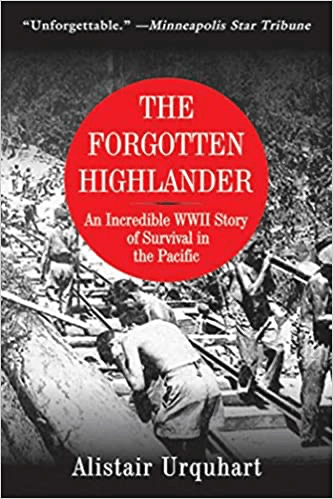
The Forgotten Highlander details the experiences of an ordinary young Scottish man drafted into Britain’s army, shipped off to Singapore, captured, enslaved before returning home to be mistreated and disrespected by the same British army that sent him away to war. I found this autobiography both a harrowing read, but also uplifting – that a man could endure so much cruelty yet not lose his own humanity.
Urquhart was shipped off from his homeland to defend Singapore, but the British army’s arrogance was quickly and decisively swept aside by the invading Japanese military. Urquhart was captured and enslaved. He was just a young lad and his experiences are told in grim detail. Even the train journey was recounted in awful detail. He is put to work by the Japanese on the railroad and then on the bridge over the Kwai River. He and his comrades are starved and beaten and worked to near-death. Urquhart is shipped out to a recovery camp constructed to demonstrate to the Red Cross that Japan’s military was humane.
Next he escapes a sinking ship that was attacked by US aircraft. One of the few survivors, he was picked up by a fishing boat and handed back to the Japanese and put into another prisoner of war camp, this time near Nagasaki from where he experienced the nuclear bomb attack.
He ends by recounting his appalling treatment by the British army upon his return to the UK and the persistent/permanent effects on his physical nd mental health.
Despite all of this, he lived till his 90s which is why, ultimately, I found the book uplifting and why I STRONGLY recommend it to anyone who likes to read non-fiction, autobiographies, and good conquering evil.
I loved this book.It’s a Psychology lesson about groups – in-groups and out-groups, my gang and your gang…
A boy on an island in danger is intriguing story told by an outsider about a community of islanders initially quarantined by a measles epidemic and then isolated and saved from another much deadlier pandemic – and then threatened by Abraham and his crew.
Aleks, a quirky teenager, is stranded on an island during the summer vacation when a quarantine is imposed by the government. Cut off from his family on the mainland, he continues to live with his grandparents and continues his daily swimming. When Aleks’ grandparents die of the measles, the local priest asks the foreigner (the story’s narrator) to take care of Aleks until the quarantine is over and his parents can come.
As more islanders succumb to the measles, a much deadlier virus sweeps the world causing chaos, panic, and billions of deaths. All contact with the mainland is lost, no one answers the telephones, the internet ceases, as do radio and television broadcasts. The islanders learn enough to know that no one from the mainland can come to their island in case they bring the killer virus. Some try to sail to the island, but the islanders turn them away using whatever means they can.
Aleks’ parents surely died in the pandemic and so while he continues to hope, he continues to live with the foreigner. As time passes, the outsiders such as Aleks, his new Papa, and other teenagers also stranded on the island all integrate into the island-community.
Several years pass and the islanders believe they may be the only people left. They learn to live simply but well. They have all they need: plenty of fresh and good food, wine, friends, family, and their religion. The islanders don’t just survive, they thrive. Until Abraham comes.
One morning a schooner appears out beyond the harbour. The fishing crews investigate and find Abraham, the schooner’s captain, and his mysterious crew. They say they’ve been sailing for months and all they want is to join the island community, but the islanders are wary. Aleks and his friends learn that Abraham isn’t to be trusted.
It’s not long before Abraham and his crew lose patience with the islanders and reveal their real intention. They want to take some of the island’s teenagers back to where they came from. And they’re willing to destroy the island to get what they want.
The islanders agree to hand over Aleks and several of his ‘foreign’ friends showing that these outsiders had never really been accepted into the community. Heated arguments in the town’s church come to nothing and so in the night, Aleks and his friends escape.
The islanders are furious. Abraham is enraged and demands ten of the island community’s teenagers instead. Plans and preparations are made for the final battle. A giant catapult that just might throw enough red-hot metal at the schooner to sink it. An old brass cannon from the museum that just may sink the schooner. A derelict and rusted old fire boat that just might start and just might ram and sink the schooner, Abraham and his crew.
But with luck on his side, and a rocket launcher, Abraham is victorious.
He claims his prize – the teenagers – and sails out of the harbour.
This is a very well-crafted and well-written book. The characters feel genuine. It’s easy to like and cheer for Aleks and his friends and it’s very easy to despise Abraham. And it’s easy to laugh with little Leo and to feel anxious as he has his appendix removed with just lemoncello for anaesthetic. The dialogue feels authentic and is well-paced.
I read A boy on an island in dangerduring the C-19 pandemic so it felt real. I loved reading this book and very strongly recommend it to anyone who enjoys an adventure, a suspense, and a play in social psychology.