Books: The Lost Children

The Lost Children by Michael Wood is a well-written, crime/detective novel with plenty of credible characters with rich back stories.

The Lost Childen by Michael Wood

Back at work after being shot, DCI Matilda Darke and her team investigate the murder of a wealthy property developer. The crime scene suggests sexual motivations. After the initial report hits the newspapers, Matilda receives a call from Peter Ogilvy, the ex-owner of a children’s home for boys. Ogilvy explains that he has made many attempts to alert police to his suspicions of sexual abuse of boys by the murder victim and his associates. Ogilvy claims his concerns have always been shelved by senior police and hopes Matilda may be the one to finally expose the abuse and explain the cover up. Matilda raises the matter with her seniors and is told to cease that line of inquiry.

And then another murder victim is found with sufficient similarities at the crime scene to connect this victim to the first. One of Matilda’s team leaks information to a journalist, a detailed article appears and Matilda’s angry seniors close down her team, its investigation and make her position redundant. Her and her team’s response is to continue, hopefully uncover enough details of the abuse, find victims and gather their statements to force an official inquiry.

This is a cleverly-written and accurately-detailed crime story with richly-created characters. It is one of a series of books ‘starring’ DCI Darke and her team. The plot is paced well and there are plenty of plot twists and back stories to keep the reader both interested and intrigued, and eager to reach the conclusion. Crime, sex, detective work, all sprinkled with some contemporary British humour. I hope to read more in the series.  

Books: The Shadow of War

The Shadow of War by Jack Murray is the first of three books following two boys/soldiers from their homes and families North Africa and the battle of El Alamein.

The Shadow of War by Jack Murray

In 1933, Danny Shaw was a schoolboy in a rural English village and Manfred Brehme was growing up in a city in Germany. Manfred enjoyed school, Danny didn’t. Danny’s father fought in the Great War, Manfred’s didn’t. Danny skips school to steal apples and enjoy the countryside with his two friends. Manfred is uneasy at school when his Jewish teacher is taken away, but the lure of the Hitler Youth is strong. Danny leaves school to help in his father’s blacksmith workshop while Manfred leaves school to sign into the German Army. When war is declared both Danny Manfred undergo basic training after which both are shipped off to North Africa – which is where this first book in the trilogy ends.

Each boy’s/soldier’s are told with clarity, humour, emotion, and a strong sense of ‘war is coming’ and that both will be involved. It’s interesting for the reader to read in such detail two soldier’s preparations for war.

The Shadow of War is well-written with careful attention to detail giving the book a strong feel of reality. The story is balanced between Manfred and Danny and their characters are well-developed through the whole book. We’re given a keen sense of their characters by following their child and teenage years, who they have strongest relationships with, their fears and weaknesses as well as their strengths. It’s reasonably clear that the later books will bring these two together in some way and I’m eager to know how that will look.

Books: Caged Little Birds

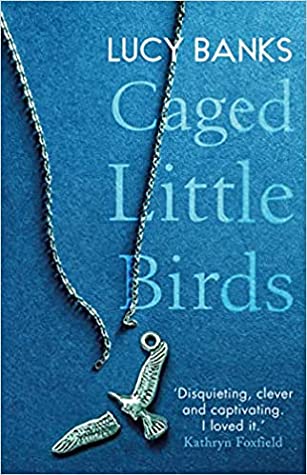
Caged Little Birds by Lucy Banks is the first-person account of Ava, who murdered a child, and her life after release from jail.

Caged Little Birds by Lucy Banks

Her sentence complete, she is living in the community under a new identity and all she wants is to return to a remote Scottish island to observe the birdlife, as she did in her childhood. Instead, the terms of her probation require her to live in the town, receive weekly visits from her over-worked probation officer, attend regular sessions with her psychiatrist, and try to find a job. Ava has too much spare time and spends much of it dwelling on her ex-lover whose son she accidentally killed (they say ‘murdered’, she says it was an accident), the boy’s cold-hearted, jealous mother, and an ex-cellmate whom she may have encouarged to commit suicide.

Ava becomes friends with her neighbour, an ex-homeless man who asks too many questions about her earlier life. When this neighbour’s adult daughter comes to stay with him Ava’s world starts to unravel. A letter arrives indicating at least one person out there knows her true identity and Ava is convinced it’s from the neighbour’s daughter. Ava sees her acting suspicioulsy when out on walks along the river and is further convinced when a brick is thrown through her window. Around this point in the plot, the pace quickens, the tension in Ava’s mind increases rapidly, she knows she must act soon before her identity and crime is revealed to everyone, and so she makes the necessary preparations…

This a real psychology novel; the author captures Ava’s anxieties remarkably well. The plot is well-crafted and the essential characters are thoroughly developed and feel like they could be people we already know. I like the use of tension and pace, rising and falling as the book progresses. The ending is neatly crafted and satisfying.

Books: Just A Boy

I enjoyed reading Just A Boy by Elena Varvello even though it wasn’t my normal reading genre. It certainly didn’t fit its description as a thriller. I would categorise it as literary /family/emotional fiction.

Just A Boy by Elena Varvello

As the title suggests, the story focuses on the past behaviour of a now-dead teenage boy although the story centres on the boy’s mother, her mother, her husband, her two daughters and her friend and their responses to the boy’s behaviour.

His initial disturbingly-odd behaviour was two house break-ins/roberries, both of which trouble his family. But what really kicks the story off is a house break-in and attack on the family (including the daughter) of his mother’s friend. In the immediate aftermath of this last incident, the boy kills himself and this is really what the book is about.

The story is a protracted examination of his family-members’ reactions, memories and ‘what-ifs’. There is an element of teenage-/adolescent-angst but ‘once-removed’ as each of the boy’s family members tries to make sense of his behaviour. This all had a strong feeling of reality; it’s likely every familiy in a smiliar situation would go through a similarly drawn-out self-examination. In this regard, although the characters were not well developed in terms of descriptions and back stories, their dialogue and behaviour gave them a vivid richness that is probably the real essence of the story. It feels like I learnt as much about the individual familiy members and their thoughts and behaviour as much as I learnt about the boy and his behaviour.

The book is well-written (perhaps I should say the translation is well-written because the book is originally written in Italian; the story is set in Italy.) It is quite literary in style, evocative and reflective, and although the plot is not linear in terms of time, it flows easily. So, not really for fans of suspense, thrillers and crime-mystery, but certainly one that fans of The English Patient (Michael Ondaatje) might enjoy.

My favourite extract from this book: ‘There are so many things we should do, and then we never can,’ Sara said. ‘We should have done them, yes.’

Books: The Hiker

I absolutely enjoyed reading The Hiker by M. J. Ford because of its carefully-constructed plot, authentic characters and the cracker of an ending.

The Hiker by M.J. Ford

Two estranged sisters, Sarah and Gemma, tell this contemporary crime thriller separately; I enjoy reading thrillers told from different characters’ perspectives because there’s often a tension deriving from one character’s information that relates to the other characters. The different perspectives kept the story’s pace ticking along.

Sarah is a successful lawyer living with her fiance, Doug, in London. Gemma is working in an elder care home, out of London, with her just laid off boyfriend. They are in debt and now in danger of serious harm by their landlord’s gangster son. Mark hatches a crazy scheme to blackmail some marijuana growers up north in Hartsbridge. 

Sarah is approached at her workplace by police making inquiries about Gemma. A burnt-out car belonging to Mark was found, one dead body inside it. The police ask if Sarah knows about Gemma’s whereabouts but Sarah hasn’t had contact with Gemma for more than 5 years. Their childhoods weren’t great: Sarah rose above it, Gemma didn’t.

Remarkably, the day after the police visit, Sarah receives a card from Gemma, sent from Hartsbridge. Despite her wedding being just days away, Sarah drives north to where the burnt-out car was found. Hartsbridge is a small village and so Sarah is able to make some quick progress in determining that Gemma was there but is not now. Sarah’s inquiries reveal some odd behaviour by some locals – sufficient for her to remain and continue her search for Gemma. 

The local police are supportive and keep Sarah informed of their investigation. Soon, evidence is found by hikers that strongly suggests Gemma has been killed. DNA samples are taken and the investigation takes on a different mood.

The plot takes several interesting twists that I’ll not reveal here – because no one likes spoilers in a review. They’re credible, well-constructed twists and the story picks up pace so that I read the second half of the book in one sitting. 

This is one of those contemporary crime thrillers, like Girl on the Train, that could be set now, feels real, and could be happening to any of us. And that’s probably what makes it such a good read – it’s outrageous but read any daily newspaper and you think, ‘this could happen to me’.  

I thoroughly enjoyed reading this book because the characters were ordinary you-or-me people. The situation was credible and the conclusion was well-constructed and satisfying. (Satisfying means I said, ‘good’ or ‘well done’ at the last page).