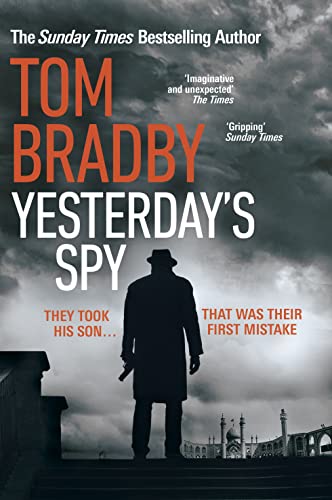
Yesterday’s Spy by Tom Bradby is a fast-paced, well-written suspense-thriller.
Yesterday’s Spy by Tom Bradby
Ex-spy and confidante of Winston Churchill, Harry Tower, learns his son, Sean, has gone missing in 1950s Iran after his article about government corruption is published.
Harry’s and Sean’s already-difficult relationship hadn’t receovered following the suicide of their wife/mother. Sean quits Cambridge and runs off to become a foreign correspondent. Harry blames himself for it all and mourns the loss of his wife and his son.
After learning of Sean’s disappearance, Harry flies into a troubled, chaotic and dangerous Tehran, teetering precariously on the edge of a coup. With the UK’s knowledge and support, the CIA is supporting the Iranian government’s overthrow to ensure the US and UK cash in on Iran’s oil. The KGB are involved, of course. The UK’s spies follow Harry to Iran, intent on exposing him as a longtime KGB double-agent.
With the help of Shahnaz, Sean’s girlfriend and daughter of a senior Iranian army officer, Harry uncovers a secret arrangement among key players to profit from oil sales and this leads them to find Sean amid the chaos of the eventually successful coup. All that remains is to escape, but as this is a suspense, that’s where I stop and you start. Because if you like suspense-thrillers you must read this book.
Bradby has plotted the story very tightly and so it’s a fast read. The characters are well-developed and their relationships feel real. The dialogue sounds authentic. An exotic setting sometimes dominates such books, but Bradbury doesn’t dwell much on the romanticism of Iran/ancient Persia (OK, just a little, but not too much).
I enjoyed this book immensely for its intensity, its pace, the genuineness of its characters and their relationships, and for the masterfully constructed ending.
James P. Redwood’s Two Ships is a suspenseful adventure story centering on young Piotr Nowak who has fled his home in Europe and joined a crew sailing to Quebec City to make their fortune by trading for beaver furs in the New World. On another ship and in a parallel adventure, Jana Mueller, a novice nun, is traveling with another nun and two priests to establish the first Roman Catholic church in Quebec City. Both ships cross the Atlantic around the same time. Jana’s ship is grounded while sheltering from bad weather near an island close to the mainland. Her crew and fellow passengers separate, some staying with the ship and some continuing their journey by rowboat to arrange a rescue mission. Both groups are attacked, some are killed and some live to continue on to their destination. Jana and her ship’s first mate are separated and begin a fraught, overland journey to Quebec City.
Two Ships by James P. Redwood
Shortly afterwards, Piotr’s ship diverts to the island and rescue’s Jana’s ship’s captain, the sole survivor of a raid by a pirating Swedish ship, before continuing on to Quebec City from where they begin their trading and beaver trapping enterprise.
When Jana and 2 others are chased by unfriendly natives, Piotr and his friends happen upon and rescue them from the attack. And so the parallel stories collide.
Meanwhile, the other nun and the two priests finally arrive in Quebec and set about building the church with the assistance of the local mafia boss who earlier lost a nasty encounter with Piotr’s group. As this is a suspense, I’ll leave my plot description there.
This is quite an adventure story, combining escape from old, warring, imperial Europe on sailing ships, overcoming adversity on land in the New World against the environment and against other people, pitching good against evil all the while building to a dramatic conclusion back in Quebec City.
The book is well-written and the plot’s tension rises and falls throughout. The parallel stories come together in a natural-feeling way and the conclusion is both suspenseful and satisfying. The primary characters are well-developed, with genuine-feeling back stories and motivations. Reading the adventure I was easily able to cheer for clearly-identifiable good people and hope for the worst for the bad ones. There were sufficient and accurate technical details to make the sailing sections and the adversities of trading and traveling in the New World around Quebec feel real.
This book was a much needed escape from the modern world of smartphones and the internet. It was a story about courage, human endeavour, right and wrong, endurance, practicalities, and in the end, triumph over adversities and enemies.
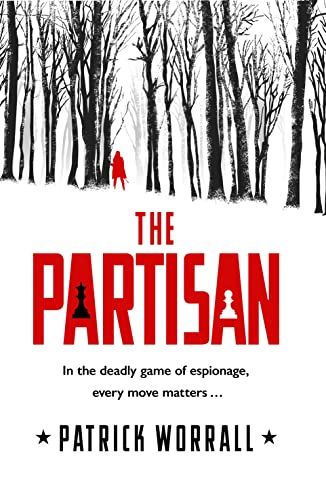
Patrick Worrall’s The Partisan is a highly-recommended, fast and twisting read spanning the 1940s and the 1960s in Britain, USSR, Germany, Lithuania, and Spain.
Michael, just out of high school and just-admitted to Oxford, is selected for a chess tournament in which a high-ranking USSR official’s daughter, Yulia, is also competing. This sets up a problematic romance that plays out across the Iron Curtain. Yulia’s father has apparently defected and her and Michael’s romance is made use of by both sides of the Cold War to track down the defector.
A parallel story is told in which Greta, a Lithuanian freedom fighter/partisan who protected two Jewish friends by living in the Lithuanian forest as the Nazi occupation was replaced by the Soviet occupation. The story of how they first fled into the forest, avoided detection, and then went onto the attack was a compelling read and is a chapter of WW2 and the Cold war that isn’t told often enough.
There is an interesting sub-story in which one of the USSR official recalls his time fighting in the Spanish Civil War, helping to set the scene for the book’s climax.
Greta’s life and missions since the end of WW2 involve tracking down ex-Nazis and exacting revenge for their war crimes. And revenge for the deaths of her two Jewsih friends, killed in the last days of WW2. Greta’s primary target is now a high-ranking official in the USSR machine and so the two stories collide with deadly effect when Yulia and Michael meet in Spain in an effort to meet Yulia’s father. Greta is also there to meet the last of her targets. The suspense builds to a crescendo in a cafe in Spain.
I enjoyed the book. It was well-paced, the characters felt real and their dialogue felt authentic. I’d have liked to have read more about chess strategies and how they can be/were converted into strategies for the characters’ real lives. The book was well-written and so it easy to read and to keep track of the characters, their interactions and the various plot lines. Perhaps more could have been written to develop the settings. I certainly recommend the book to readers interested in intrigue, WW2/Cold War, and suspense.
Lingering notes: I read this during the first few days of the Russian invasion of Ukraine with the obvious undertones of USSR reunification. As The Partisan is somewhat centred on the issue of the Soviets’ ‘mistreatment’ of Lithuanians and also one person’s mission to right the wrong of war crimes, I couldn’t help thinking that these two plot lines would’ve been better told in separate books. Each story would’ve made an excellent read on its own. Combining them seemed contrived and unnecessarily complicated this one story. I still highly recommend it though.
A few weeks ago I wrote about what creates the flavours of coffee – the sugars, acids, oils, and caffeine. Even the heat of the coffee affects how we perceive the flavour. This week, I’ll try to explain why Arabica beans are considered the most flavoursome.
About two-thirds of the world’s coffee production is Arabica. It is thought by most drinkers to be more flavoursome than the other beans because it has more sugar, more oil, more acid and less caffeine. The sugar makes the coffee feel better in our mouth and the higher oil content gives it a better flavour.
Arabica beans are more difficult to grow and the plant usually produces less beans. It is naturally low in caffeine which is toxic to most insects, so Arabica plants are more vulnerable to insects. As a result, Arabica is usually grown at higher altitudes because the colder climate deters insects. The altitude range of between 1000 and 2000 metres above sea level seems to be ideal for growing the Arabica plants.
This higher altitude means the coffee’s cherries ripen more slowly and this means the sugars in the cherries develop more slowly. This allows the farmers to harvest the cherries at the optimum time, when the sugar levels are highest. The higher altitude also means Arabica beans have a higher acidity level, which gives coffee its fresh taste and feel in the mouth, the same way freshly-picked fruit feels and tastes. The higher acidity in just-picked fruit gives it the taste and feel that we perceive as ‘fresh’. The same sensory perception applies to Arabica coffee.
And that’s what’s so special about Arabica coffee beans.
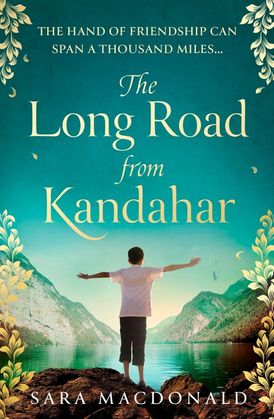
The Long Road from Kandahar by Sara MacDonald is an interesting and engaging read, tracing the lives of an English boy and a Pakistani boy and their families.
The Long Road From Kandahar by Sara MacDonald
Finn is English, the son of a British Army Major and a Finnish mother. Raza is the son of an elderly, retired Taliban fighter, now a simple farmer in Waziristan, North-West Pakistan. Finn’s family live in their Army quarters in Germany, but he attends a boarding school in Cornwall. Raza lives with his elderly father in a simple house in the mountainous Swat Valley where he tends a goat herd and struggles to grow enough food during a drought.
Knowing that Raza’s two elder brothers will soon try take him for the Taliban, Raza’s father has secretly arranged for Raza to live with distant, wealthy relatives in London. After a short and unhappy stay in London, Raza wins a scholarship to the same boarding school in Cornwall that Finn attends where they are roommates and soon become close friends. They spend much of their non-school time at Finn’s grandparents’ beach house.
Finn’s father, Ben, is posted to Lashkar Gah in Afghanistan’s Helmand Province, about a thousand kilometres from Raza’s home village in Pakistan. Finn’s mother, Hanna, is desperately unhappy at the prospect of returning alone to Germany and moves back to her home in Finland, beginning what Finn believes to be his parents’ eventual separation/divorce. Raza and his new parents make an emergency return trip to Pakistan because his elderly father is hospitalised. Initially, Raza is determined to stay to care for his father but is soon convinced to return to England after the threat of being kidnapped/recruited into the Taliban by his older brothers becomes evident. While Raza is in Pakistan, Finn’s father is seriously injured during a patrol and is evacuated back to England. Ben’s injuries include an amputated leg and an abdominal wound. Hanna flies to England but it’s clear the marriage is over, causing Finn even more grief. Raza returns and joins the extended family as it comes to terms with Ben’s injuries. There is a vivid paragraph in which Raza describes similar limb amputation injuries among Pakistani children and the reader can’t help to make the obvious comparison between the massive resources available to foreign troops compared to what limited medical treatment the local children have available.
This was a difficult story to read. It was principally about the eventual breaking apart of Finn’s family, but it could have been a more interesting story of the destruction of poor Pakistani families and their culture by the war between the Taliban and western powers that overflows into Waziristan. The story, like the real situation in Afghanistan, was tipped heavily towards the story of Finn, his English life and his English family’s response to Army life and Ben’s injury.
The book is set in both Cornwall and the northwest tribal area of the Swat Valley and Islamabad/Rawalpindi. These are vividly colourful and vital places and I thought the writing didn’t do either setting justice. The dialogue, almost all of which is between friends and family members, didn’t flow as naturally as it would in real life. I enjoyed reading the story and was thoroughly engaged with the characters, but I thought the focus of the story was off-centre. The story seemed predominantly about Finn, his relationship with his family, Ben’s injuries and the eventual break up of the marriage and family, when I thought a more compelling story was that of Raza leaving his mountains, travelling to bustling, dusty, edgy Peshawar, on to Rawalpindi and then to an utterly new and unexpected life in England.




 Books and beans