Books: The Journey

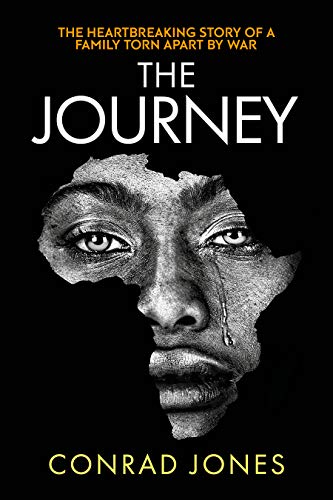
The Journey by Conrad Jones

The Journey by Conrad Jones is the story of Kalu, a UK-trained doctor living in Monguno, Northern Nigeria and his family. Kalu, Esse, his wife, and 4 children, become refugees when Boko Haram overruns Monguno. These early scenes are not for the faint-hearted – guns, machetes, rape, burning…

Kalu has been making secret preparations for such an event and he quickly gathers his family in his surgery, distributes necessary supplies and money among them. They escape, initially at night and on foot, through the forest surrounding the town. They find the Land Cruiser that Kalu had hidden earlier and so the long, dangerous journey begins. The danger comes at the family in many forms: Boko extremists who race ahead of the invasion, corrupt border guards, other desperate refugees also trying to escape, and simple opportunists. But they’re also helped by sympathetic well-wishers. Ultimately, Kalu and his family make it to the Libyan coast where they board a trawler to cross the Mediterranean to Italy. The boat capsizes, the family is separated and… I’ll stop there rather than spoil the story’s ending.

The plot races along giving the reader a tiny sense of the desperation the family must feel as it remains just ahead of danger. The story mostly focuses on Kalu and Esse with their children’s characters not being developed in as much detail as I’d have liked. It was an engaging and ultimately satisfying read with several twists and threads to keep track of and wonder about.

Lingering notes Recently I was reading about the taste of coffee and encountered the term ‘lingering notes’ which describes the tastes that remain long after the coffee has been drunk. I wondered whether ‘lingering notes’ are a combination of the taste and memories associated with it. I wondered if the same applies to a book because I finished The Journey several days ago and am well into my next book, but I have ‘lingering notes’ about it. Kalu’s family was incredibly fortunate to have survived the initial attack on their town by Boko Haram, incredibly fortunate to have made the necessary and substantial preparations to be able to escape, and incredibly fortunate to have escaped from Boko Haram. I know it’s ficton, but I like fiction to be ‘at least possible or plausible’. That has been one lingering note for me. Another is that The Journey had several incomplete threads: the attack on the Christian community, the attack on the town’s village and the people’s lives afterwards, and perhaps even some back story of some of the Boko Haram fighters – who are/were they and why are they as they are now? All of which is to say that while The Journey was a fast-paced story, it felt incomplete because the story of any refugee fleeing their home and risking everything is a complex story with many perspectives and deserves to be told fully. These are my ‘lingering notes’.

Books: The Spectral Island

The Spectral Island by Stephen de Burges is an excellent read and I thoroughly recommend it to those who enjoy intrigue and suspense in a contemporary setting.

The Spectral Island by Stephen de Burges

Dr Jamieson is an independent investigator/agent called in by the UK government to investigate unusual activtiy on Ivundé, in the Indian Ocean as detected by satellite images, The primary cover story is that a school/madrassa is being built on the island. The real story is that there is gold. But Dr Jamieson quickly deduces that the gold story is also a ruse. On the suspiciously dark side, there is North Korean, Chinese, and Iranian involvement including a Chinese naval fleet in the Indian Ocean and a North Korean submarine just off the the island’s coast. There is intriguing interplay between the governments of UK and USA, the military on Diego Garcia, the embassy staff on the island, Ivundé’s corrupt president, and the locals who assist Dr Jamieson.

The writer gives the reader plenty of expert detail to support the well-written and well-paced plot. The primary characters are described and used well to advance the story which felt very credible throughout and kept me interested and keen to read more throughout. The language and writing style make the book both easy to read and also carry an air of authenticity and credibility. I would certainly like to read more by this author.

Books: Dirt Town

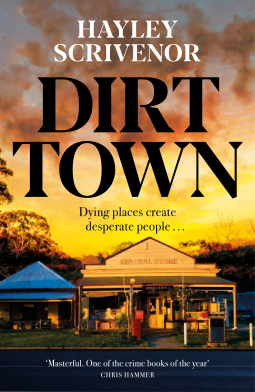
Dirt Town by Hayley Scrivenor is the story of twelve-year-old Esther who goes missing on her way home from school in the small, rural, Australian town, Durton (a.k.a. Dirt Town). It’s also the story of Durton’s other children and their economically- and socially-challenged relationships.

Dirt Town
by Hayley Scrivenor

The two city-detectives, Sarah and Smithy, who are assigned to the case uncover a drug operation. Initial investigations and interviews reveal little relating to Esther’s disappearance with no clear suspects, motive, or even evidence of a kidnapping, murder or otherwise. 

 The story is well-written and is presented from multiple perspectives: Ronnie (Esther’s best friend), Lewis (Esther’s next-best friend), Esther’s parents, and also Sarah (the lead detective) all reveal complex stories of their own. Each of these supporting characters have real and troubled relationships and lives that enrich the central story.

The author conveys the smallness and intensity of a rural community: inter-relatedness, long histories and unforgotten grievances, unhappy marriages and parenting struggles. But the author also conveys the innocence of children’s perceptions of real life – of Esther’s disappearance, single parenting, friendships, and fragile rural-Australian economics. The story of finding Esther is paced perfectly, with just the right amount of character and plot development to tempt the reader into reaching premature conclusions.  

Dirt Town is a compelling and enjoyable story that kept me interested from start to finish. 

Books: The Lensky Connection

The Lensky Connection by Conrad Delacroix

The Lensky Connection, by Conrad Delacroix, is set in mid-1990s St Petersburg and Moscow, Russia. 

FSB officer, Maj. Valeri Grozky, is assigned to police St Petersburg’s organised crime problem, especially drugs, a cause near to his heart after his elder brother died from an overdose while battling his post-war demons. Maj. Grozky forms an uneasy alliance with a journalist, Natassja Petrovskaya, who shares information with him about the current organised crime situation, alluding to collusion and corruption in official offices. Maj. Grozky is reassigned to a Military Intelligence operation set up to protect the President Yeltsin’s reputation against a possible expose relating to an oligarch and a failed oil company by a US Senate Committee during the lead up to the Presidential election. Secret plots are in play in both the US and Russia, and Maj. Grozky, with Natassja’s help, gets much closer to the truth than anyone expected. 

It’s a fairly long and convoluted story – the plot is complex, the characters even moreso, which gives the whole work a strong sense of authenticity. In fact, what I liked about this book, even more than it’s intriguing plot, was the strong feeling of reality – authentic dialogue, suspicions among even the closest of characters, and the uncertainty about which officials were corrupt and which were not. At times it was difficult to know which characters were on which side, further adding to the intrigue and suspense. The crisp writing style easily keeps the reader attached to the unfolding plot. An appropriate amount of supporting detail gives the reader a strong feel for the setting. (And it was good to read a book set in Russia that didn’t go on and on about the cold or the snow.)  

Beans: If Socrates drank coffee.

The life unexamined is not worth living. Socrates said that so if he drank coffee, he’d also have said the coffee unexamined is not worth drinking. 

Photo by Kaboompics .com on Pexels.com

Let’s examine the taste of coffee. What we all think of as the sense of taste is really a group of physiological responses, or sensations including taste perceived by the tongue, smell perceived by the nose, as well as a haptic perception of texture or feel in the mouth, and finally the sensation of temperature. Food technologists say the taste of coffee is the combination of these 4 perceptions: taste, smell, texture, and temperature. Both taste and smell, psychologists tell us, are linked to our emotions and memories and that’s all to do with the involuntary nervous system in the most primitive part of our brain and all of that is associated with evolution. Taste and smell are closely associated with memory because we have to remember the tastes and smells of food or drink that made us very sick and which may kill us. This explains why the taste of food and drink is important to us and why we (Socrates included) spend time examining it.

The tongue detects sugars such as fructose, glucose, and lactose as well as some alcohols and some amino acids and reports all of them to the brain as sweet.

The acidic sensation we sense from drinks such as lemon juice or white wine or food such as fresh apples is caused by hydrogen ions that are dissolved in a watery solution.

Photo by Lukas on Pexels.com

Food or drink containing sodium chloride or the salts associated with potassium and magnesium are detected and reported to the brain as salty. 

The tongue is extra-sensitive to bitter food or drink and it’s thought that there are more sensors detecting bitterness than the other elements of taste, likely because bitterness is related to the toxicity of the foods and drinks that could kill us. 

The savoury taste, redolent of a beef broth, is caused by glutamic acid or aspartic acid which are associated with many different food proteins such as ripe tomatoes, asparagus, meat, and cheese. MasterChef calls it umami.

Good coffee tastes good because it combines an agreeable balance of sweetness and acidity. Good coffee is naturally sweet and that sweetness is complemented by the right degree of acidity. Some people describe coffee as tasting bitter; if it does, it is usually not good coffee, although some may simply be incorrectly describing the combination of sweetness and acidity, incorrectly calling that bitter.  

Photo by Jessica Lewis Creative on Pexels.com

I think Socrates would’ve said this is a good start to examining the taste of good coffee, but there is definitely more (yes,I know, he’d have said it in Greek, obviously) so I’ll post more soon.