It’s a suspense/thriller. Brother (Dan) working for MI5 and sister (Cathy) working for police/army in Leeds during WW2 are coincidentally together on a small team chasing down an escaped and dangerous German spy. The suspense comes from pressure on Dan by his bosses to capture the spy and close the case before collateral and psychological damage is done. The book is overflowing with scene setting (Leeds in WW2) and character development, e.g. Dan’s girlfriend being sacked from the spy catcher project, Cathy’s boyfriend shipped off on a troop ship to North Africa, the rest of the Special Investigative Branch in Leeds, as well as Cathy’s best friends and parents living their civilian lives under the threat of German bombs. The story is primarily told from Cathy’s perspective and although it’s hinted at several times, the book doesn’t dwell too much on the fact that she’s a woman struggling for acceptance in a male-dominated career/situation. The plot is well-paced, the characters are credible and likeable, and the ending is tense and satisfying.
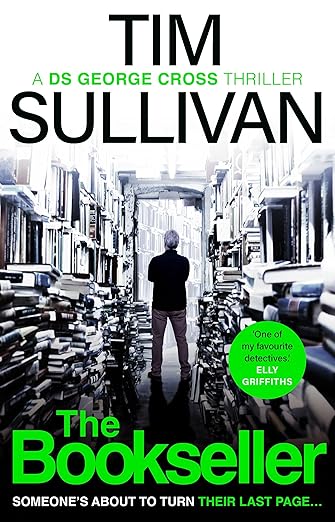
Tim Sullivan’s The Bookseller is an engaging murder mystery that explores the world of rare books.
The Bookseller by Tim Sullivan
Set in Bristol (UK) where a bookseller is found murdered, the story follows DS George Cross and colleagues as he tries to solve the crime. George Cross is an intriguing protagonist, notable for his emotionless quirks and methodical approach. His relationships with his colleagues add some lightness to the story, though they might feel a bit too well-crafted at times – I suspect the police workplace may be a little less rosy than it’s portrayed in this story. Still, his unique personality keeps the narrative going along.
The is compelling, with the crimes and feuds within the book trade providing a new and intriguing backdrop. Sullivan uses the details of this niche industry effectively, adding depth without slowing the plot’s pace. It’s not just about solving the crime; it’s about understanding the characters and their motives, which makes this story satisfying. While the plot twists and turns, it remains clear and easy to follow. The resolution ties things together well, leaving no loose ends. It’s a straightforward but well-executed mystery that keeps you guessing without being overly complex.
The Bookseller is a very enjoyable read for anyone who loves murder mysteries with a unique setting and a slightly unconventional detective. It’s a satisfying story that balances intrigue, character development, and a good dose of insider knowledge about the book world.
R.M. Green’s Small Lives, Big World is an exquisite collection of short stories that masterfully weaves ordinary and extraordinary aspects of human experience together. The book captivated me with its skilfully crafted characters, richly detailed, vivid settings, and thought-provoking plots.
Small Lives, Big World: A Collection of Short Stories From Near and Far by R. M. Green
Green has a strong talent for bringing everyday moments to life while imbuing them with intrigue and poignancy that stay with you long after you’ve turned the page.
The characters in this collection are as diverse as the settings they inhabit—an Ottawa suburban housewife, a Chinese shopkeeper, a private in the trenches of World War I, and a six-year-old train traveler, to name just a few. Each of them feels authentic and fully realized, their emotions and struggles palpable. Green’s ability to create characters who are simultaneously specific and relatable is quite remarkable. You don’t just read about their little lives; you step into them.
Equally vivid are the settings, which range from the bustling Parisian streets to tranquil yet enigmatic corners of Central America. The book’s descriptive prose breathes life into each location, steeping the reader in the sights, sounds, and atmosphere of these places. Whether it’s the tropical backwaters or the claustrophobic office of a factory, the settings feel essential to the stories they frame.
What truly places this collection on the top shelf, however, is the storytelling. Each story is intriguing and often takes unexpected, twisty turns that kept me thoroughly engaged. Humor and tragedy, despair and hope, are balanced to create a tapestry of human experience that is both entertaining and deeply moving – and real. Themes of love, fear, dreams, and resilience thread through the stories, uniting the characters and settings seamlessly.
Small Lives, Big World is a book that invites you to journey alongside its characters, sharing their lives, joys, and struggles – but only for a little while and with each story, I was left wanting more. For well-traveled readers and those with an interest in exploring the richness of human experience across the globe, this collection is a must-read. I can’t recommend it highly enough.
A later edit… I wanted to add to my review… this book is a perfect example of one of those wonderfully crafted books that is a totally satisfying read that for some random reason is not on best-seller lists, but jolly well should be because it’s a WAAAAY better read than most of the mediocre-to-rubbish stuff that the big publishing houses push onto consumers in the big book stores.
Black Sun by Owen Matthews is a gripping thriller that held my attention from the first page. Set in 1961 in the ultra-secret Soviet city of Arzamas-16, the story is set against a high-stakes project to build the world’s most powerful nuclear bomb. A young physicist dies under suspicious circumstances and KGB Major Alexander Vasin is sent to investigate, only to discover an elite city of scientists working in secret.
Black Sun by Owen Matthews
Black Sun is very well paced. The author crafts an easy-to-follow plot that pulled me along at just the right speed, building anticipation with each chapter. The plot alone made the book hard to put down and despite the inevitable Physics of nuclear bomb construction was never overwhelming or confusing. The characters are also impressively constructed. The author gives them just enough backstory to make them feel real and relatable without slowing the story. I found myself invested in each character’s motivations, which added an emotional depth to the story that’s rare in thrillers.
The book is based on a real event and the story, setting and characters feel authentic, capturing the atmosphere of paranoia and ambition that defined that era and culture.
Matthews has created a compelling, thoughtful novel, easily as good as and possibly better than Tom Rob Smith’s USSR-era books such as Agent 6. I thoroughly enjoyed reading Owen Matthews’ Black Sun and am excited to know that it is the first in a three-book series.
If you enjoyed reading this book review, please Subscribe and Follow.
The ends of things by Sandra Chwialkowska is a first-class read and I highly recommend it to anyone looking for a fast, easy read with easy-to-like characters, a charmingly unobtrusive setting and a twisty plot and excellent writing.
I really enjoyed Laura as the main character (perhaps there’s a little of Laura in most of us) and found myself cheering her on from the beginning. Her desire to explore the world, but not having the courage to go alone felt relatable, so when she jumps at the chance to go on a romantic trip with her new-ish boyfriend (colleague – which must mean trouble, doesn’t Laura know the oldest rule?) Dave, I was rooting for Laura. And sure enough, Dave turns out to be a creep. I wasn’t at all keen on him, especially as the story progressed, and honestly, I was pretty disappointed he got away with all his shady behavior without any real consequences. There was definitely a moment where I thought he might’ve even been responsible for Diana’s disappearance. Diana was a single guest at the couples resort that Dave and Laura had come to for a few days of vacation.
Diana and Laura go hiking while Dave does work with the hotel owner/manager. Diana goes missing, there are creepy characters who make excellent suspects, the police are involved, Laura loses her job for contacting the police and initiating bad PR for the hotel which is a client of her and Dave’s law firm… Things aren’t looking good when Dave flies home without Laura, Luara is ‘requested’ by the police to stay on the island and seems to have made herself a suspect in Diana’s disappearance. Let’s leave the plot there in case I reveal too much.
Speaking of Diana, she remains a total enigma to me, but strangely, I’m okay with that. The mystery surrounding her really added to the story’s tension. Even though I was left with questions, her presence (and eventual absence) kept me hooked. Laura’s obsession with uncovering what happened to Diana felt so real and intense, and I loved how the seemingly perfect vacation turned into a nightmare where nothing was as it seemed.




 Books and beans